

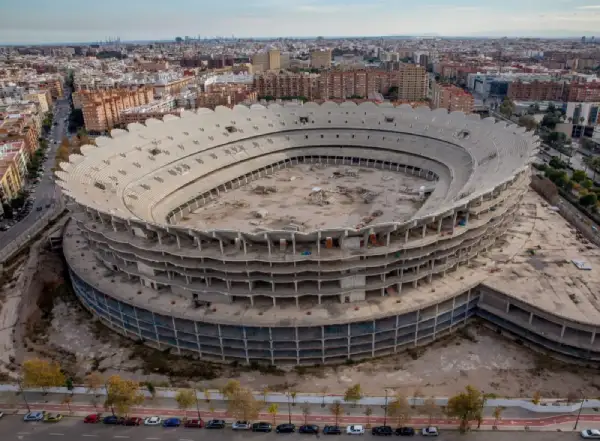

For sixteen years, it stood unfinished on the edge of Benicalap: a concrete skeleton that became one of Valencia’s most embarrassing symbols. The Nou Mestalla. A stadium that broke ground in 2007, ran out of money in 2009, and sat frozen for a decade and a half while the city grew around it.
That story is over. Construction resumed in January 2025. The roof structure is going up. Valencia CF has confirmed a summer 2027 opening. And for buyers paying attention, the question is no longer whether this changes the property market in northern Valencia. It already has.
What Research Says: Do New Stadiums Actually Raise Property Prices?
The short answer is: it depends on what comes with them.
Academic research (including a well-known study from the London School of Economics) consistently shows that major stadium developments can have a significant positive effect on surrounding property values. Arsenal’s Emirates Stadium and the new Wembley both generated price increases in surrounding areas that, when measured, were large relative to the cost of construction itself.
But the same research also shows that a stadium on its own, dropped into a neighbourhood with no wider development, can have a much more limited effect. What makes the difference is integration: housing, hotels, retail, improved infrastructure, and new transport links arriving alongside the stadium.
This distinction matters when you look at Benicalap, because what is happening there is not just a stadium. It is a complete urban transformation.
What Is Actually Happening in Benicalap Right Now
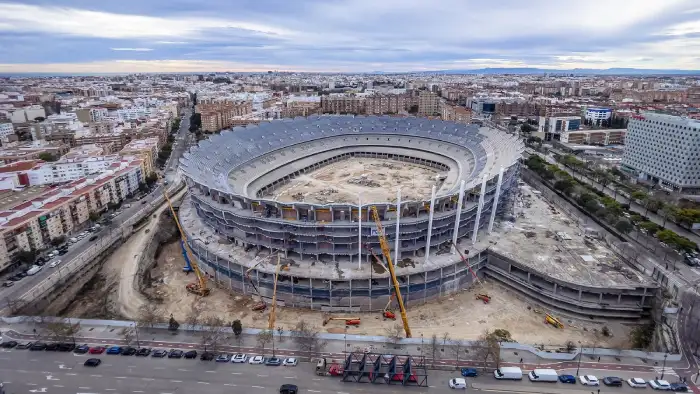
Construction back in full swing: the 50 steel roof pillars are now being installed. Opening planned for summer 2027.
Photo: Valencia CF
To understand the opportunity, you first need to understand where Benicalap was a few years ago.
It was one of Valencia’s least sought-after neighbourhoods. Few quality shops, a poor reputation, and a slow property market. The kind of area that locals from other parts of the city would not particularly consider.
Fast forward to 2026: Benicalap now has the highest concentration of new-build projects of any neighbourhood in Valencia. The 70,000-seat Nou Mestalla is taking shape. 50 steel pillars of 40 metres each are currently being installed to support the roof structure. Alongside the stadium itself, the following is planned or already underway:
– A four-star hotel with 245 rooms
– 650 tourist apartments
– A municipal sports complex, with 10 million euros in funding from Valencia CF as a condition set by City Hall
– A new wave of modern residential developments with amenities that were previously absent from the area
This is the integrated development model that research says drives real price appreciation.
One thing worth saying honestly: not everyone in Benicalap is enthusiastic. Some neighbourhood associations have called the development “a speculative operation.” That concern is legitimate. Gentrification always has two sides. Prices go up, but so can the pressure on existing residents. As a buyer or investor, knowing that tension exists gives you a more complete picture than the promotional brochures will.
—
Buying Property in Benicalap and the Surrounding Neighbourhoods
While Benicalap is at the epicentre, the price effect is already spreading outward. The neighbourhoods worth watching are:
Benimaclet sits directly adjacent to Benicalap. It already had a strong identity (a lively, independent character popular with young professionals and expats) and has been one of Valencia’s most active property markets for several years. The stadium development reinforces that momentum. Properties here tend to be older stock at lower entry prices than the new-build projects in Benicalap itself.
Orriols is to the east of Benicalap and has historically been one of the most affordable neighbourhoods in Valencia. It is beginning to attract investor attention precisely because it has not yet moved as much as its neighbours.
Torrefiel similarly sits in the northern orbit. Less polished, lower prices, and now within easy reach of a 70,000-seat stadium and everything that comes with it.
One thing I consistently notice when I walk these streets with buyers: quality of life can change dramatically from one building entrance to the next. The same street in Orriols can have a well-maintained block with solid residents next to a building that tells a completely different story. International investors browsing listings online simply cannot see this. They make decisions based on the neighbourhood name and the asking price, and they miss opportunities because of it, or worse, they walk into the wrong one. On the ground, you learn to read a street at the level of individual doorways. That difference in liveability is exactly where overlooked value hides, and exactly where an investor who knows how to look can find it.
—
The Hidden Opportunity: What Happens to the Old Mestalla?
This is the part of the story that does not get enough attention, and in my view it may actually be the more significant opportunity for property buyers.
When Valencia CF moves to the Nou Mestalla in 2027, the historic Mestalla stadium (located in the heart of the city, in the Mestalla/Algirós neighbourhood) becomes available for redevelopment.
The numbers are striking. The plot covers nearly 90,000 square metres. Valencia CF expects to sell it for around 150 million euros. The current plans envision seven buildings arranged along the main avenue, rising up to 22 storeys, with one landmark building permitted up to 29 storeys. Estimates suggest around 500 apartments could ultimately be built on the site, at prices that could exceed 500,000 euros per unit.
The location is everything. The old Mestalla sits near the Blasco Ibáñez corridor, close to the Cabanyal waterfront district and the Ruzafa neighbourhood: two areas that have already seen enormous price appreciation over the past decade. A development of this scale, in this location, will reshape the property values of the streets around it.
The sale process is underway. The developer has not yet been chosen. Construction is years away. But buyers looking at the Mestalla and Algirós neighbourhoods today are buying ahead of a transformation that will be hard to miss once it begins.
—
What This Means If You Are Buying in Valencia Now
I have been active as a buyer’s agent in Valencia for several years, and the northern neighbourhoods have gone from an afterthought to one of the most common topics in conversations with international buyers. A year ago, almost no one was asking about Benicalap. That has changed.
I have guided several buyers into Benicalap and Torrefiel over the past year: buyers I had to convince, because their first instinct was to look elsewhere. What is telling is the feedback I get afterwards. They confirm what I was already seeing: international interest in these neighbourhoods is growing, with more viewings, more competition on good properties, and more buyers from outside Spain asking the right questions. And yet prices here remain significantly lower than comparable areas in Barcelona or Madrid. Valencia is Spain’s third largest city, and in established neighbourhoods like Ruzafa that gap has been closing fast. In areas like Benicalap, you are still buying into a major European city at prices that simply would not exist under a different postcode. The stadium is an accelerant. The underlying undervaluation is the foundation.
A few things I tell every buyer who asks me about this area:
Timing matters more than people think. The stadium opens in 2027. The hotel and apartments are still being built. The old Mestalla has not been sold yet. You are still buying before the full effect lands in the market. Once the ribbon is cut and the first match is played, the story is already priced in.
New-build versus existing stock is a real choice here. Benicalap has a lot of new-build activity, and new builds come with guarantees and modern specifications. But older apartments in Orriols and Benimaclet currently offer better value per square metre, with the same upside exposure to the development.
Most buyers ask about tourist rental. Very few ask about long-term rental, and that is where the real opportunity often is. In practice, most of the international buyers I work with arrive with short-term rental income in mind: Airbnb, tourist licences, peak-season returns. The appeal is obvious. But since May 2026, Valencia has introduced the strictest tourist rental regulations in Spain. No new licences in residential buildings, and a hard cap of 2% of properties per neighbourhood. That door is largely closed for new residential purchases. The conversation I end up having about long-term rental is often one of the most valuable ones we have.
What most people overlook is that long-term rental (renting to tenants for a year or more) has its own compelling logic, especially here and especially now. Spanish tax law gives landlords a 60% reduction on net rental income from long-term contracts. In designated stressed areas of Valencia, that reduction can go higher still. The income is stable, the management is simpler, and with careful tenant screening, the risks are manageable. Add to that the fact that demand for quality rental housing in Valencia from expats, remote workers, and young professionals is consistently strong and growing, and the income case is solid without depending on tourist licences at all.
Now layer in the Nou Mestalla effect. A neighbourhood undergoing this kind of transformation does not just generate rental income. It consolidates the value of the asset underneath it. You are not just collecting rent. You are holding a property in an area where a 322 million euro investment and a complete urban renewal programme are structurally anchoring prices upward. Long-term rental gives you the income today. The stadium and everything around it gives you the capital appreciation over time. Those two things together are a stronger argument than tourist rental income alone.
The old Mestalla is a story to follow. You do not need to buy on the site itself. Buying within walking distance of a 90,000 square metre redevelopment site, before the developer is named and construction begins, is how early positioning works in property.
—
The Bottom Line
The Nou Mestalla is not just a football stadium. It is an anchor investment that is already reshaping how buyers, developers, and investors see the northern half of Valencia. The urban transformation of Benicalap is real and measurable. The potential in the surrounding neighbourhoods is significant. And the second chapter (the redevelopment of the old Mestalla in the heart of the city) has barely been written yet.
If you are considering buying in Valencia and this kind of positioning interests you, I am happy to talk through what it looks like in practice. Every situation is different, and the right approach depends on your timeline, your budget, and whether you are buying to live or to invest.

Render: Valencia CF