

AREA GUIDE - VALENCIA CITY
Valencia: History, Neighbourhoods and life in the city
Over two thousand years of history, and a few things most guides leave out
Valencia has been a city for more than two thousand years. This guide covers what it is actually like to live in Valencia today: the history that shaped it, the neighbourhoods that define it today, the property market as it stands in 2026, and a few things most city guides tend to leave out. It is written by an independent buyer’s agent who works in the Valencia property market day to day.
Where the name comes from
Valentia. The Romans didn’t name their cities carelessly, and this one they named for strength. Founded in 138 BC by the consul Decimus Junius Brutus along the banks of the River Turia, the full name was Valentia Edetanorum (Valentia of the Edetani), the Iberian people already living on this stretch of Mediterranean coast. It was built as a settlement for veterans of the Lusitanian Wars: soldiers who had fought in what is now Portugal and were rewarded with fertile land under a reliable sun.
The Italian pottery found in its earliest excavated layers, imported from Campania, tells you these weren’t men starting from nothing. They were trading, building, connected. They were right about the name. It has held for over two thousand years.
A history that doesn't lack for drama
Sixty-three years after its founding, Pompey burned Valencia to the ground. The city had been used as a base by forces loyal to the rebel Roman general Sertorius, caught in the crossfire of the Sertorian War rather than choosing the losing side. When Pompey finally prevailed, Valencia paid the price. What followed is less heroic than the burning: the city was abandoned for around fifty years. It was rebuilt under Augustus, on the same ground, along the same lines. A stubbornness that would become a pattern.
The Visigoths came next, though between 554 and 625, the Byzantines briefly held a coastal strip that included Valencia, a chapter most histories skip. Then in 714 the Moors arrived in Valencia, calling the city Balansiya, and governed it for five centuries. That period left deeper traces than most people realise. The Moors built the irrigation network: the acèquies, channels still crossing the Valencian countryside today, and introduced rice cultivation to the region. Without them, there is no paella, a fact the city rarely advertises.
In 1094 came El Cid: Rodrigo Díaz de Vivar, soldier for hire and one of history’s more complicated heroes. He didn’t take Valencia quickly. He laid siege to the city for a year before it fell, then governed it for five more, governing Muslims and Christians alike, accountable to no king, loyal to no crown but his own. After his death in 1099, his wife Jimena held the city for another three years before finally abandoning it. She took El Cid’s body with her to the monastery of San Pedro de Cardeña near Burgos, where both are still buried today. Alfonso VI of Castile came to help hold the city but, facing the advancing Almoravids and unable to defend it, chose to burn Valencia to the ground rather than surrender it intact. It fell back to the Moors as a ruin. Valencia has a habit of being fought over, and a habit of outlasting whoever wins.
James I of Aragon, El Conqueridor, retook the city from the Moors in 1238 and established the Kingdom of Valencia: not a province, not an extension of Castile or Aragon, but its own realm with its own laws and its own language. That language, Valenciano, remains co-official alongside Spanish today. It’s still visible on street signs and in daily life, and it explains something about the city’s persistent sense of being specifically itself.
The 9th of October, 1238, the day James I entered the city, is still celebrated as Valencia’s national day. Each year, a civic procession carries the Senyera, Valencia’s ancient striped flag, through the city centre. The evening ends with a large fireworks display over the Turia Gardens. It is one of the few occasions when Valencia’s characteristic understatement gives way to something considerably louder.
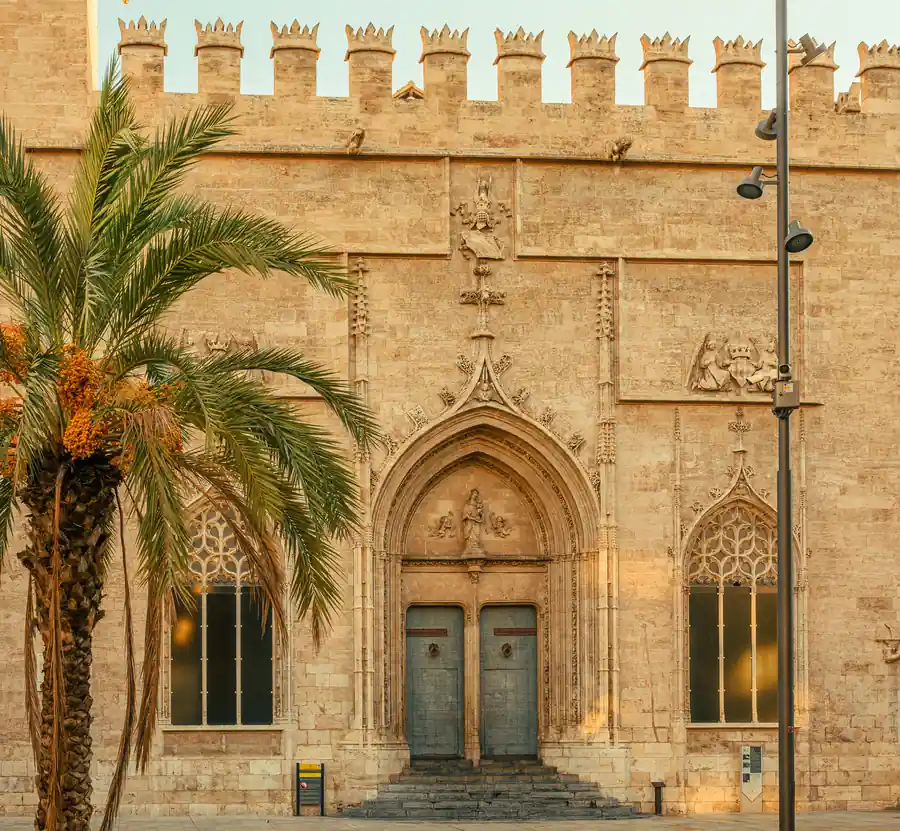
The 15th century was Valencia’s golden age. Silk money built the Llotja de la Seda, the Silk Exchange, now a UNESCO World Heritage Site and one of the finest examples of late Gothic civil architecture in Europe. In 1474, the first book ever printed on Spanish soil came off a press in Valencia, predating Castile by years. Valencia’s Cathedral houses what many consider the world’s most credible candidate for the Holy Grail. The Santo Cáliz is a dark red agate cup mounted in medieval gold, dating to the first century AD, with a documented journey from Jerusalem through Rome and the Pyrenees to the Aragonese royal court, arriving in Valencia in 1424. Whether it truly is the chalice from the Last Supper cannot be proven, but it is serious enough that both Pope John Paul II and Pope Benedict XVI drank from it during their visits to the city.
The Germanías, a revolt of craftsmen and merchants against the nobility and the Moorish workforce, broke out in 1519 and shook Valencia for four years. At its peak in 1521 the rebels briefly controlled the city. When royal forces finally crushed the uprising, hundreds were executed, and its leaders met particularly brutal ends. It didn’t end well, but it’s the kind of episode that explains why Valencia has always had an undercurrent of doing things its own way, whatever the official position happens to be.
"It was rebuilt under Augustus, on the same ground, along the same lines. A stubbornness that would become a pattern."
Then, in October 1957, after weeks of steady rain, the River Turia flooded catastrophically. Waters reached five metres in some streets. Around eighty people died. The government’s response was radical: reroute the river entirely, around the south of the city. The old riverbed sat empty for years while arguments about what to do with it ran on. Valencians eventually fought, successfully, to turn it into a park rather than the motorway initially planned. The result is the Turia Gardens: almost nine kilometres of green running through the city’s heart, connecting every neighbourhood from west to east without a car in sight. It is now the spine of the city, and usually the first thing residents mention when asked why they stayed.
The neighbourhoods: beyond the obvious
Every guide to Valencia covers Ruzafa and El Carmen, and not without reason. Ruzafa (its name from the Arabic rawda, meaning garden, a reminder of who planted things here before the Reconquista) is the city’s most fashionable district: independent boutiques, colourful facades, terraces that fill by mid-morning. El Carmen is the medieval core: narrow pedestrian streets, Roman walls still visible, the city at its most photogenic. Both are worth knowing. Both are also written about extensively. What follows is less documented.
El Cabanyal
Beachside · Fishing heritage · Rapid transformation
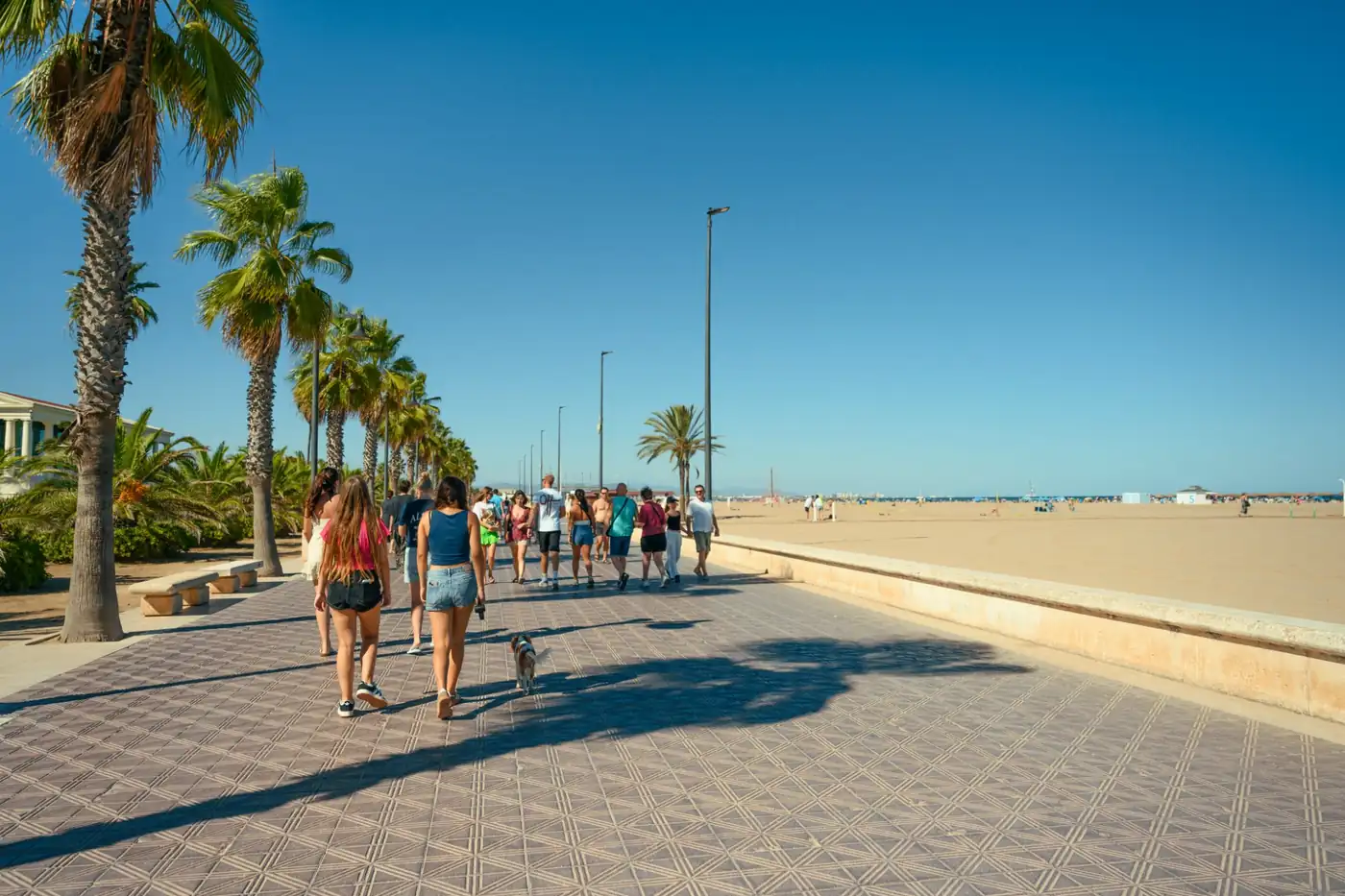
El Cabanyal began as three separate fishing settlements: Canyamelar, Cabanyal and Cap de França, that were absorbed into Valencia in 1897. The fishermen who lived here built humble whitewashed houses along straight streets running parallel to the sea. Then, as wealthier families came for summer residences and brought modernist architecture with them, the locals did something typically Valencian: they adapted the style into something they could afford. The result is the neighbourhood’s ceramic tiled facades: geometric panels in faded blues, greens and ochres, every house slightly different from its neighbour. These earned El Cabanyal its designation as an Asset of Cultural Interest in 1993.
Twenty years later, the city tried to demolish around 1,600 of these homes to extend an avenue through the neighbourhood. Residents organised, fought, and largely won. The courts ultimately rejected the demolition plan, though around 125 homes were lost before the project was stopped. In 2020, The Guardian ranked El Cabanyal the third coolest neighbourhood in Europe. It has its own beach, its own annual theatre festival, and a mix of long-standing fishing families, younger creatives and international arrivals that is genuinely unlike anywhere else in the city. The gentrification is visible and still incomplete. That tension is part of its character right now, which means the window to buy here before it fully closes is smaller than it was.
Benimaclet
Village within a city · Students & creatives · Genuinely local
Benimaclet was an independent village until 1878. That’s worth pausing on. Absorbed by Valencia’s expansion, it still hasn’t entirely surrendered. The narrow pedestrianized lanes, the two-storey village houses with interior gardens, the community allotment gardens buffering it from the ring road. None of this feels like a city neighbourhood because it wasn’t one until recently, and it hasn’t forgotten what it was.
A resident who moved from the city centre put it simply: “We were surprised by how quiet it is. Now we hear birdsong in the mornings.” There is a music society, the Centre Instructiu Musical, that has been operating for over a century. There is a Friday market that is still a market rather than a food experience. Tram lines reach the beach in under ten minutes.
Benimaclet draws university students and younger professionals, and a growing number of internationals who’ve worked out that you don’t need Ruzafa prices to get the Valencia that Ruzafa used to be. It is probably the most undervalued neighbourhood in the city for what it offers.
Campanar
Absorbed village · Family-friendly · Turia Gardens access
Campanar is what happens when a village gets absorbed by a city and simply refuses to change its personality. The old quarter, distinct from the modern apartment complexes that have grown around it, has the pedestrian streets, small colourful houses and church plaza of somewhere considerably smaller than Valencia. The bell tower that gives the neighbourhood its name still marks the centre. Tapas bars and bakeries ring the plaza; the people drinking coffee there are, overwhelmingly, people who live there.
It sits north of the Turia Gardens, which means immediate access to almost nine kilometres of park on foot. The Bioparc, Valencia’s open-format zoo designed around African savanna habitats rather than cages, is a short walk away. Families tend to find Campanar before everyone else does. Prices remain notably lower than equivalent central districts, and the neighbourhood has developed enough modern infrastructure (transport, schools, amenities) to make it fully functional without requiring a car.
Arrancapins
Between centre and west · Quieter alternative · Mixed and local
Arrancapins sits between Ruzafa and the city’s western edge and tends to attract a different kind of buyer: people who want Ruzafa’s proximity without Ruzafa’s noise and price trajectory. It’s quieter, more mixed in age, less obviously fashionable. The streets are wider. There are neighbourhood bars that have been there for thirty years and aren’t planning to change. Property prices here are among the most accessible within reasonable walking distance of the centre, and the neighbourhood is gradually attracting buyers who’ve done their research rather than followed the crowd. It doesn’t have a defining characteristic that makes it easy to pitch. For the right buyer, that is exactly the point.
Marxalenes
North of Campanar · Turia Gardens access · Rarely mentioned
Marxalenes barely appears in property searches, which is itself a reason to mention it. Just north of Campanar and bordering the Turia Gardens, it is residential, green and quiet in a way that surprises people who stumble across it. There is no defining feature that makes it easy to market, no headline neighbourhood story, no recent Guardian mention. Prices are lower than almost anywhere else this close to the centre. For buyers who want space, greenery and access to the city without paying for a postcode, it tends to come up late in the search, if at all.
The city today: honest and fair
In recent years Valencia has quietly accumulated a title it seems almost indifferent to: one of the most liveable cities in the world. InterNations has ranked it first among expat destinations multiple times. The reasons are easier to feel than to list: 300 days of sun a year, a beach reachable by bike in fifteen minutes from the city centre, a food culture that is both genuinely excellent and genuinely affordable, and a size that feels like a city without demanding you live like one. It is large enough to have everything, compact enough that you don’t spend your life commuting between the things it has.
Valencia is visibly mid-transformation, and honest writing about it requires saying so. International buyers (Dutch, Belgian, German, American, Latin American) now account for a significant share of transactions in the central districts. Ruzafa has priced out many of the people who gave it its character. Property values across the city hit a fresh record in mid-2026, up around 16% year-on-year according to data from Spain’s College of Property Registrars, driven by sustained demand from both Spanish buyers priced out of Madrid and Barcelona, and an increasingly international pool.
Working with buyers across the city’s districts, what I notice is that the neighbourhoods people arrive convinced they want and the ones they end up choosing are often different. Ruzafa comes up in every early conversation. It ends up on fewer shortlists than it starts on, usually once buyers have spent time in Arrancapins or Campanar and seen what the price difference buys them in terms of space and calm. That pattern repeats often enough that it’s worth saying early rather than after several viewings.
And yet Valencia has not become a theme park of itself, which is what makes it worth writing about. The Mercado Central still sells vegetables to people who will cook them today, not to tourists photographing them. The mid-morning coffee on a terrace is still a ritual, not a lifestyle product. Paella is eaten at lunch, over wood fire, the traditional way. And if you order it at dinner, or make it with chorizo, someone will tell you, politely but clearly, that you have made a mistake.
For buyers considering the wider province
The DANA of October 2024 — a storm system that dropped a year’s rainfall in hours across parts of the province — deserves a place in any honest account. More than 230 people died, though Valencia city itself was largely spared: the Turia diversion, built after the catastrophic 1957 flood, shielded the city centre. The devastation fell on the towns to the south: Paiporta, Alfafar and others in the L’Horta Sud. Anyone looking seriously at property in the province needs to understand flood risk zones properly, not as a reason not to buy, but as part of the homework any significant purchase deserves.
The city runs at its own pace. That pace is slower than most northern European buyers are used to: administration takes longer, builders arrive when they arrive, lunch is a commitment rather than a break. Most people who move here come to see that pace as one of the reasons they came rather than something to overcome. But it’s worth knowing before you arrive rather than discovering once you’re there.
It is, taken whole, a city that has been burned to the ground and rebuilt, flooded and rerouted, occupied and reconquered, threatened with demolition and saved by its residents. It has held its name for over two thousand years. Something in it seems to fit.
Frequently Asked Questions
Is Valencia a good place to live?
For most people who move here, yes. Valencia consistently ranks among the top cities in Europe for quality of life: 300 days of sun a year, a beach within cycling distance, a food culture that is both excellent and affordable, and a cost of living significantly lower than comparable cities in western Europe. InterNations has ranked it the world’s top expat destination multiple times. The city is large enough to offer everything you need, compact enough that you don’t spend your life commuting between the things it has.
Which neighbourhood in Valencia is best to live in?
It depends on what you’re looking for. Ruzafa is the most fashionable and internationally known district, with the price tag to match. El Carmen is the historic core. For something less documented: El Cabanyal offers beach access and a genuine neighbourhood character that is still forming; Benimaclet has a village feel within the city; Campanar suits families who want green space and lower prices; Arrancapins offers central proximity without central prices. The right neighbourhood depends on your lifestyle, budget and how long you intend to stay.
How far is Valencia from the beach?
The city’s main beaches, La Malvarrosa and Las Arenas, are roughly four kilometres from the city centre and reachable by bike in around fifteen minutes, or by tram in under ten. El Cabanyal, one of the neighbourhoods covered in this guide, sits directly alongside the beach. For quieter stretches of coastline, the beaches south and north of the city are within 30 to 45 minutes by car.
What were the Valencia floods of 2024?
In late October 2024, a DANA storm system dropped an exceptional volume of rainfall in a matter of hours across parts of the Valencia province. More than 230 people died. The worst-affected areas were towns in the L’Horta Sud, south of the city, including Paiporta and Alfafar. Valencia city itself was largely protected by the Turia diversion, the infrastructure built after the 1957 flood that reroutes the river around the southern edge of the city. Anyone considering property in the wider province should understand flood risk zoning before purchasing.
What are property prices like in Valencia city in 2026?
Valencia city recorded year-on-year price growth of around 16% in the first half of 2026, with average prices reaching approximately €2,786 per square metre. Prices vary considerably by neighbourhood: central districts like Ruzafa and El Carmen command significant premiums, while areas such as Campanar, Arrancapins and Marxalenes remain notably more affordable for comparable quality of life. The market has been driven by consistent demand from international buyers and Spanish buyers priced out of Madrid and Barcelona.
What language is spoken in Valencia?
Spanish and Valenciano are both official languages in the Comunitat Valenciana. In daily city life, Spanish predominates in most interactions, but Valenciano is widely present on street signs, in local government, and in cultural life. The two languages are closely related but distinct. Most residents switch between them naturally. Internationals navigating daily life will find Spanish sufficient, though any effort with Valenciano is noticed and appreciated.
Thinking about a purchase in Valencia province?
We work with buyers independently across the whole region, city and surrounding towns alike. If it would help to talk through what you're looking for, we're happy to start there.
Cookie Consent
Your privacy, your choice
We use cookies to understand how visitors use our site and to improve our advertising. You can accept, reject, or choose which cookies you allow.
Cookie Preferences
Choose which cookies you allow. Essential cookies are always on because the site needs them to work. You can change your choice at any time.
Essential cookies enable basic functions and are necessary for the proper function of the website.
Statistics cookies collect information anonymously. This information helps us understand how visitors use our website.
Google Analytics is a powerful tool that tracks and analyzes website traffic for informed marketing decisions.
Service URL: policies.google.com (opens in a new window)
Marketing cookies are used to follow visitors to websites. The intention is to show ads that are relevant and engaging to the individual user.
Measures the results of our Google Ads campaigns.
Service URL: policies.google.com (opens in a new window)
Live chat to answer your questions.
Service URL: www.intercom.com (opens in a new window)