
If you have ever been in Valencia during a fiesta, you know how quickly it wins you over. The Fallas in March, with giant sculptures on every corner and fireworks at two in the afternoon. A summer night on the beach for Sant Joan. A village square full of tables and music in August.
It is one of the best reasons to live here. And it raises a question that rarely comes up at a viewing: what is this street like during the fiestas?
A flat that is quiet in October can have a marching band under the window at eight in the morning in March. A village house that feels peaceful in spring can sit on the procession route of a week-long fiesta in September. None of this shows up in a listing. It shows up after you have signed.
In short, the fiestas are a reason to buy here, not a reason to hesitate, as long as you know the street before you sign. This guide covers the main fiestas in Valencia and the surrounding region, what they mean for the people who live there all year, and what to check before you buy.
The fiesta calendar: what residents actually notice
Valencia has a fiesta for almost every month, and each one feels different depending on where you live. Visitors see the highlights. Residents live with the preparations, the noise and the closed streets. Here are the ones that matter most when you choose where to buy.
| Fiesta | Where | When | What residents notice |
|---|---|---|---|
| Fallas | Valencia city and many towns, including Alzira, Gandia and Xàtiva | Late February to 19 March; main days 15 to 19 March | Some 380 neighbourhood commissions, daily firecrackers, brass bands from 8 am, streets closed for monuments and tents |
| Semana Santa Marinera | El Grau, Canyamelar and Cabanyal, by the sea | Holy Week (March or April) | Processions through the seafront neighbourhoods, road closures around the routes |
| Moros y Cristianos | Alcoy and many towns in the south | Alcoy: three days around Sant Jordi (23 April); 24 to 26 April in 2027 | Parades, gunpowder salvos and bands for several days |
| Nit de Sant Joan | Valencia city beaches, mainly Malvarrosa and Cabanyal | Night of 23 June | Bonfires and crowds on the beach, with noise on the seafront until around 4 am |
| Feria de Julio and Batalla de Flores | Valencia city | July, closing with the flower battle on the last Sunday of July | Concerts and events across the city; the flower battle, with over 1.2 million carnations, fills the Paseo de la Alameda |
| La Tomatina | Buñol | Last Wednesday of August | One hour of tomato throwing (12:00 to 13:00), ticketed, limited to 22,000 people in 2026 |
| Fira d’Agost | Xàtiva | 15 to 20 August, with events from early August | A fair held since 1250: over 100 events, free concerts and fireworks in the town |
| Fira i Festes | Gandia | Early October, 2 to 5 October in 2026 | Four days of concerts, markets, a correfoc and gunpowder around 3 October, the saint’s day of Sant Francesc de Borja; the fairground stays for over two weeks |
| Fiestas patronales | Every town and village | Usually summer or early autumn | A week or more of processions, music in the square and late nights |
Public holidays in Valencia in 2027
Besides the fiestas, Valencia city has 14 official public holidays in 2027. On these days notaries, the land registry and banks are closed, so no signing can take place. Notaries also often close for a few days around Easter, in August and at Christmas. Worth knowing if you are planning a viewing trip, a bank appointment or the completion.
| Date | Holiday | Applies to |
|---|---|---|
| Friday 1 January | New Year’s Day (Año Nuevo) | All of Spain |
| Wednesday 6 January | Epiphany (Reyes) | All of Spain |
| Friday 22 January | Sant Vicent Màrtir, patron saint of the city | Valencia city |
| Friday 19 March | Sant Josep, last day of the Fallas | Valencian Community |
| Friday 26 March | Good Friday (Viernes Santo) | All of Spain |
| Monday 29 March | Easter Monday (Lunes de Pascua) | Valencian Community |
| Monday 5 April | Sant Vicent Ferrer | Valencia city |
| Saturday 1 May | Labour Day | All of Spain |
| Saturday 9 October | Day of the Valencian Community (9 d’Octubre) | Valencian Community |
| Tuesday 12 October | Spain’s National Day (Fiesta Nacional de España) | All of Spain |
| Monday 1 November | All Saints’ Day (Todos los Santos) | All of Spain |
| Monday 6 December | Constitution Day | All of Spain |
| Wednesday 8 December | Immaculate Conception | All of Spain |
| Saturday 25 December | Christmas Day | All of Spain |
Every other town sets its own two local holidays, usually around its patron saint. Sant Joan (24 June) is no longer a regional holiday in 2027.
The Fallas deserve their own section. For anyone buying in Valencia city, they are the fiesta that shapes daily life the most.
Living next to a casal faller
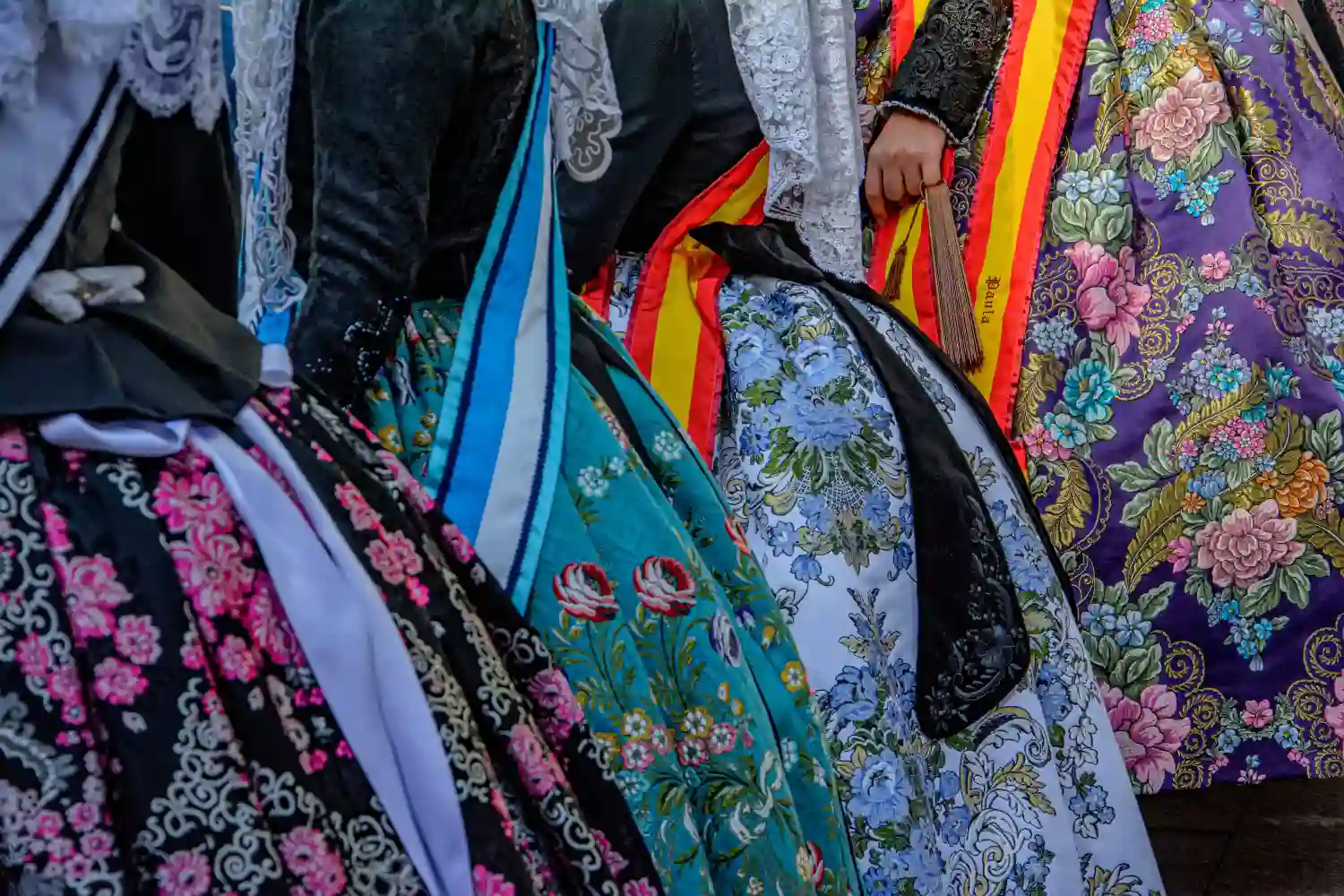
The Fallas are not organised by the city. They are organised by the neighbourhoods. Valencia has 382 fallas commissions, each with its own clubhouse, the casal faller, and a record 128,675 registered falleros in 2026, according to the city council. Every commission builds its own monument, usually on a square or a street corner near its casal.
What is a casal? A casal faller is the clubhouse of a neighbourhood’s fallas commission, a bit like a local social club. It is usually a ground-floor space in an ordinary residential building, recognisable by the commission’s name and coat of arms on the door. Members meet there all year for dinners, parties and fundraising for their monument. In the weeks around the Fallas it becomes the centre of the neighbourhood: cooking, eating, music and celebrations, often in a large tent in the street right outside.
For a visitor, that means a festival on every corner. For a resident, it depends on which corner.
What a casal nearby means
- Months, not days. The official programme starts in late February, and the mascletà fires at 2 pm every day from 1 March. The casal holds dinners and parties through the year.
- The morning wake-up call. During the main days, the despertà starts at 8 am, with a brass band and firecrackers moving through the streets.
- Closed streets. In 2026, the city allowed 280 commission tents (carpas) in the streets from 4 March, almost two weeks before the main days. From the afternoon of 16 March until the early hours of 20 March, the whole historic centre is closed to private traffic. Residents can drive in with proof of address, but the city advises them to do so only between 6:30 and 11:00.
- Noise until late. Music and fireworks continue into the night, with the cremà on the night of 19 March.
None of this is a reason not to buy. Many residents love it, and some streets are far quieter than others. The point is to know before you sign, not after.
How to find out
- Check the list of fallas commissions per neighbourhood on the website of the Junta Central Fallera (fallas.com). A commission is usually named after the streets or square where its monument stands, so if the street of the property appears in a name, the falla is right there.
- Walk the street and look for a casal, a ground-floor venue with a commission name and shields on the door.
- Ask the neighbours, or the porter of the building. They will usually know where the monument and the tent go each year.
- If you can, visit the street during the Fallas, between 15 and 19 March. One afternoon tells you more than any listing.
Considering a home in Valencia? Send us the address and we will tell you what that street is like during the Fallas.
Fiestas in the towns and villages
Outside the city, the fiestas are smaller but closer to home. Every town has its fiestas patronales, in honour of its patron saint, and in a village they take over the whole centre. Xàtiva has held its Fira d’Agost since 1250, with six days of fair, concerts and fireworks from 15 August. Gandia celebrates Fira i Festes in early October. Alzira, Gandia, Xàtiva, Sueca and Torrent even have their own Fallas in March, officially protected as cultural heritage by the Valencian government since 2015.
Not long ago I drove through Alzira to drop my son at his sports club, and had to take a long detour because a whole street was closed. I never found out why. That says a lot. Between processions, markets, festivals and each town’s own fiestas, streets here close so often that even after years you don’t know them all. Locals simply plan around it. But if that street had been mine, I would have wanted to know before I bought.
For buyers, three things are worth knowing.
- The centre is where it happens. A townhouse on the main square or on the procession route is at the heart of the fiesta: music until late, fireworks, and chairs and tables in the street. A house on the edge of town notices much less.
- It is how you get to know people. In a village, the fiestas are when neighbours meet, and when newcomers are invited in. Joining a peña (a local group of friends who celebrate the fiestas together) or the fiesta committee is often the fastest way to belong.
- It is short. In most towns the fiestas last one or two weeks a year. For plenty of newcomers, that is exactly the Spain they came for.
If you are looking at a village house, ask when the fiestas are and where the processions pass. The town hall website or its social media pages usually have the programme.
Five questions to ask at a viewing
The seller’s agent is unlikely to bring this up. It is not in their interest to mention that a lot of streets close for days in March. So ask it yourself:
- Is there a casal faller or a monument in this street or on the nearest square?
- Do any processions or parades pass by here, and when?
- When are the local fiestas, and where do the concerts and fireworks take place?
- Can I still get my car in and out during the fiestas?
- What do the neighbours say about it? Ask them directly, not the agent.
If you are buying from abroad and cannot visit in March, ask someone on the ground to check. It takes ten minutes, and it can save you years of frustration, or confirm that you have found exactly the lively street you wanted.
The fiestas are a reason to live here, if you choose the right street
One summer I took my family to the Batalla de Flores. The floats came down the Alameda full of Valencian children, armed with tennis rackets, swatting the carnations straight back at the crowd. Grandparents, teenagers, whole families on both sides of the barrier, all throwing flowers at each other. Even the flowers are local: the 1.2 million carnations are grown in the huerta around the city, in Alboraya, Meliana and Alcàsser. It felt like exactly what it is, an old tradition that still brings a whole city together. Flower power, Valencian style.
The fiestas are part of what makes Valencia feel alive, and for many buyers they are part of why they come. The difference between loving them and dreading them is often a few hundred metres: the street with the casal, or the one around the corner.
That is the kind of thing we check for you. We work only for buyers, never for sellers (here is how we are paid), so we tell you what the listing does not: the noise, the closed street in March, the procession route. And the quiet corner two streets away.
Found a home you like? Send us the address and we will tell you what that street is like during the fiestas. Still looking? Book a free intake call and tell us where you are searching. We will tell you what life there is like all year round, including the weeks the listing does not mention.
Frequently asked questions
When are the Fallas in Valencia?
The Fallas officially open with the Crida in late February (22 February in 2026). From 1 March there is a mascletà every day at 2 pm on the Plaza del Ayuntamiento. The main days are 15 to 19 March, ending with the cremà on the night of 19 March, when some 750 fallas are burned across the city.
Is it noisy to live in Valencia during the Fallas?
In many streets, yes. From the morning wake-up call at 8 am to fireworks late at night, the main days are loud, especially near a casal faller or a monument. Other streets, even in the centre, are much quieter. It depends on the exact address.
How do I know if there is a falla near a property?
Check the list of commissions per neighbourhood on fallas.com. Commissions are usually named after the streets where the monument stands. Then walk the street to look for a casal, and ask the neighbours or the building’s porter where the monument and the tent go each year.
Do villages near Valencia have fiestas too?
Yes. Every town has its fiestas patronales, usually in summer or early autumn, and many towns also celebrate their own Fallas. In a village, the fiestas mainly affect the centre and the procession routes.
Are the Fallas a UNESCO heritage event?
Yes. The Fallas were added to UNESCO’s Representative List of the Intangible Cultural Heritage of Humanity on 30 November 2016, as the “Valencia Fallas festivity”.