

Area guide · La Costera
Living in Xàtiva and La Costera (2026): A Castle Town, Real Spanish Life and Lower Prices
Most buyers who look for a home near Valencia look at the city or the coast. Far fewer look at Xàtiva, an hour inland, and that is a pity. Living in Xàtiva means a real Spanish town of about 31,000 people, with a castle on the hill above it, a train to Valencia, its own hospital and a British school.
Over the past two years, I have seen more and more foreigners move to Xàtiva. With prices in Valencia city rising every year, they come for what is getting harder to find near the coast: a good home in a place with history, services and daily life all year round. Homes here cost little more than a third of what they cost in Valencia city.
It is not for everyone. Summers are hot, the beach is a drive away and the international community is still small. This guide covers the towns, travel times, schools, healthcare, prices and the honest downsides, so you can decide whether it suits you.
At a Glance: How Far Is Everything From Xàtiva and La Costera?
| Town | Valencia center | Valencia airport | Gandia beach |
|---|---|---|---|
| Xàtiva | 55 min to 1 hr 20 | 45 min to 1 hr 5 | 50 min to 1 hr 10 |
| La Llosa de Ranes | 50 min to 1 hr 15 | 45 min to 1 hr | 55 min to 1 hr 10 |
| Canals | 55 min to 1 hr 20 | 45 min to 1 hr 5 | 50 min to 1 hr 5 |
| L'Alcúdia de Crespins | 55 min to 1 hr 20 | 45 min to 1 hr | 45 min to 1 hr 5 |
| Moixent | 1 hr to 1 hr 30 | 55 min to 1 hr 15 | 55 min to 1 hr 15 |
Driving times measured in Google Maps for a weekday at 11:00, October 2026. The lower figure is with light traffic.
By train
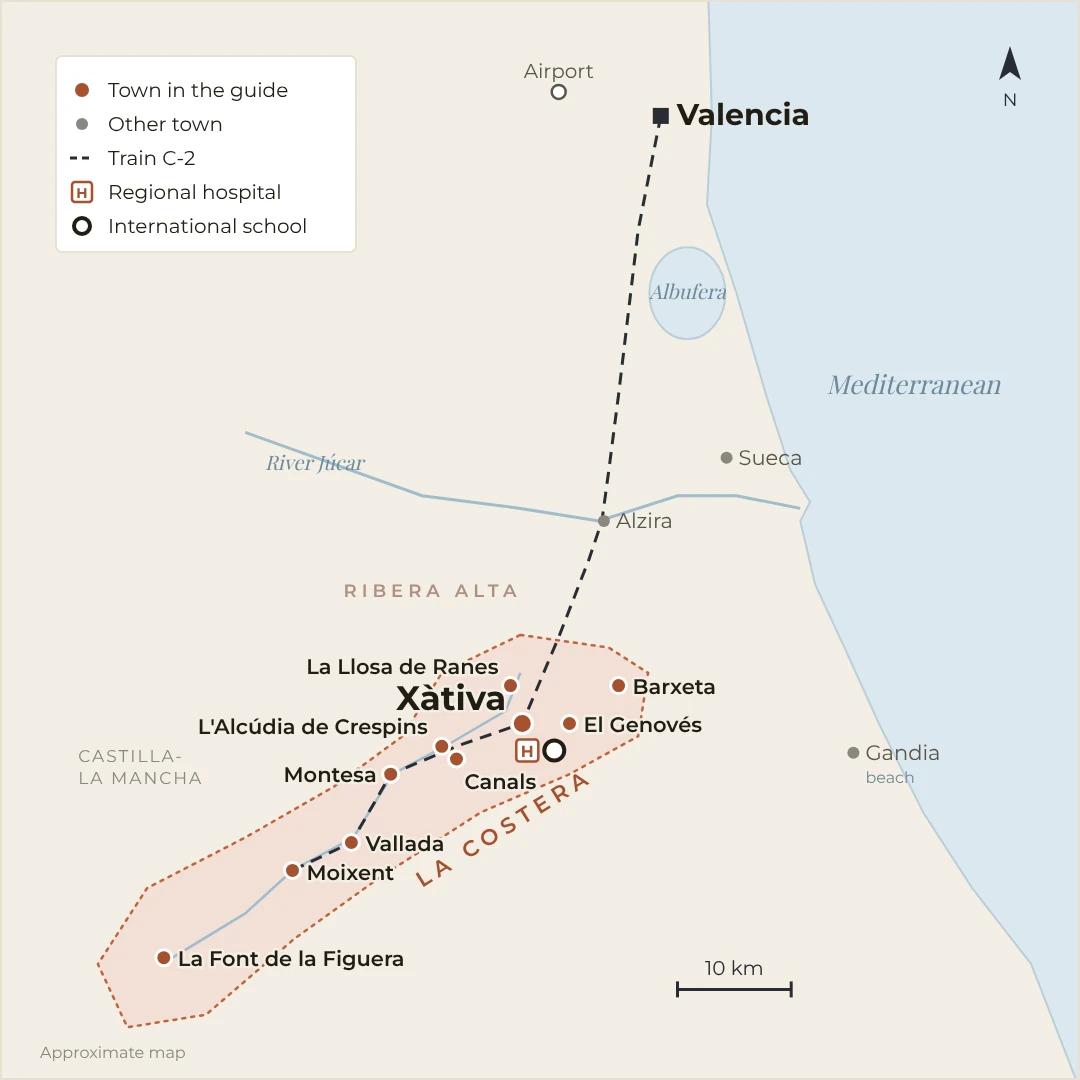
Xàtiva is the main station of the region. The Cercanías C-2 line (Renfe's commuter trains) runs from Xàtiva to Valencia's Estació del Nord, next to the city center, in about an hour, with a train every 15 to 30 minutes. A handful of faster regional and long-distance trains also stop in Xàtiva, cutting the trip to about 40 to 50 minutes. Beyond Xàtiva, the C-2 continues to L'Alcúdia de Crespins, Montesa, Vallada and Moixent, but less often: about every 30 minutes to L'Alcúdia and about once an hour to Moixent, a journey of nearly an hour from Xàtiva (Renfe Cercanías Valencia). The station of L'Alcúdia de Crespins lies between that town and Canals.
What Makes Living in Xàtiva and La Costera Different
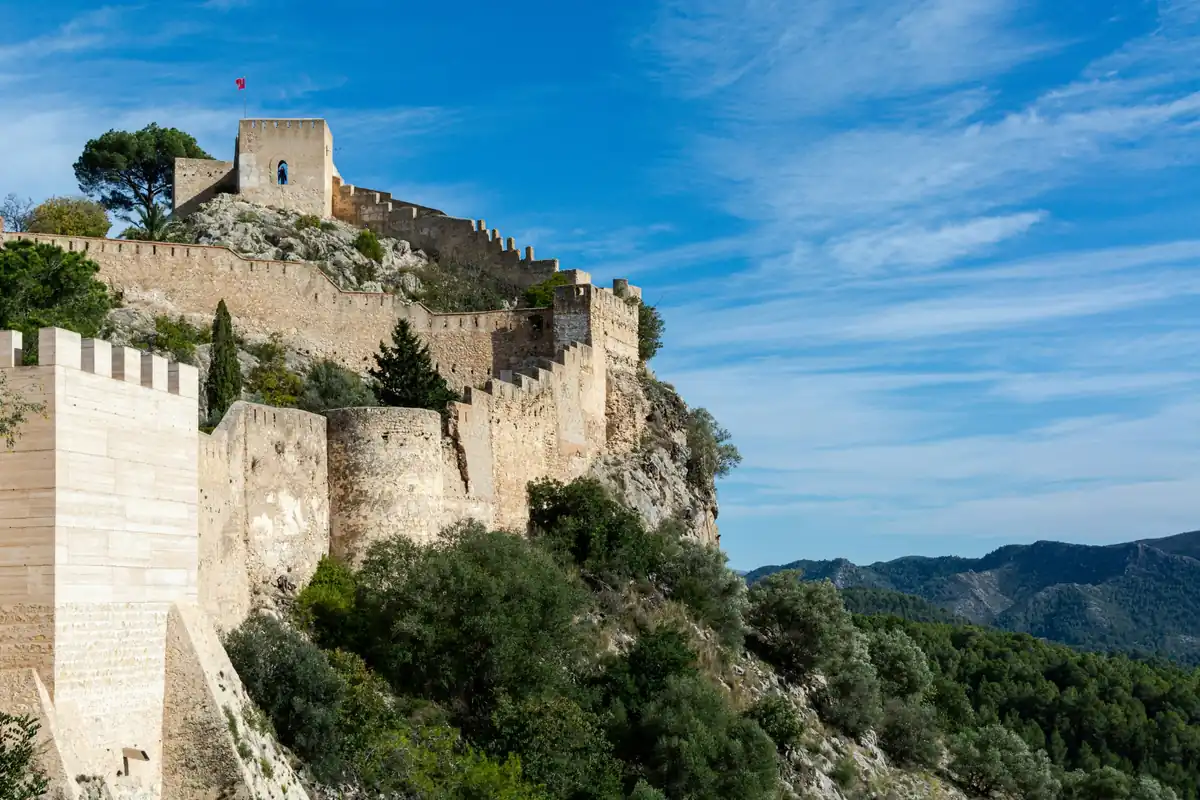
La Costera is the inland valley that runs southwest from the orange groves of the Ribera toward the mountains on the border with Castilla-La Mancha. The A-35 motorway and the railway follow the same valley, which is why the region has always been a crossroads. Xàtiva sits at its eastern end, about 60 km from Valencia and 25 km from the sea, at the foot of a long ridge crowned by its castle. When I drive in after dark, the castle is lit up along the whole ridge, and the town below looks like something out of a fairy tale.
The landscape is different from the flat Ribera. Here you find low mountains covered in pine, valleys with olive, almond and carob trees, and vineyards toward the west. The climate is more continental than on the coast: hotter in summer, with cooler nights in winter.
Valencian is the everyday language in every town here (Valencian language law, Ley 4/1983, art. 35). You get by with Spanish, but you will hear Valencian in the street, at the market and at school.
A Short History: Romans, Popes and a Painting Upside Down
Few towns of this size have as much history as Xàtiva. The Iberians called it Saiti, and under the Romans it became Saetabis, famous for its fine linen. In the 12th century, under Muslim rule, Xàtiva became one of the first places in Western Europe where paper was made.
The Borja family, known in Italy as the Borgias, came from here. Alfons de Borja was born near Canals in 1378 and became Pope Callixtus III; his nephew Roderic de Borja, born in Xàtiva, became Pope Alexander VI (Diputació de València, La Costera).
The most famous story is more recent. In 1707, during the War of the Spanish Succession, Xàtiva sided against Philip V, the first Bourbon king of Spain. After his victory, the king had the town set on fire and renamed it San Felipe, after himself. Since then, the people of Xàtiva have been called socarrats. The word is Valencian for "scorched" or "burned", and you may know it from paella: the socarrat is the crispy, slightly burned layer of rice at the bottom of the pan. What began as a mocking name became a badge of pride, and people in Xàtiva still proudly call themselves socarrats today. The town has not forgiven the king either: in its fine arts museum, a portrait of Philip V hangs upside down. It was restored in 2025 and went straight back on the wall the wrong way up.
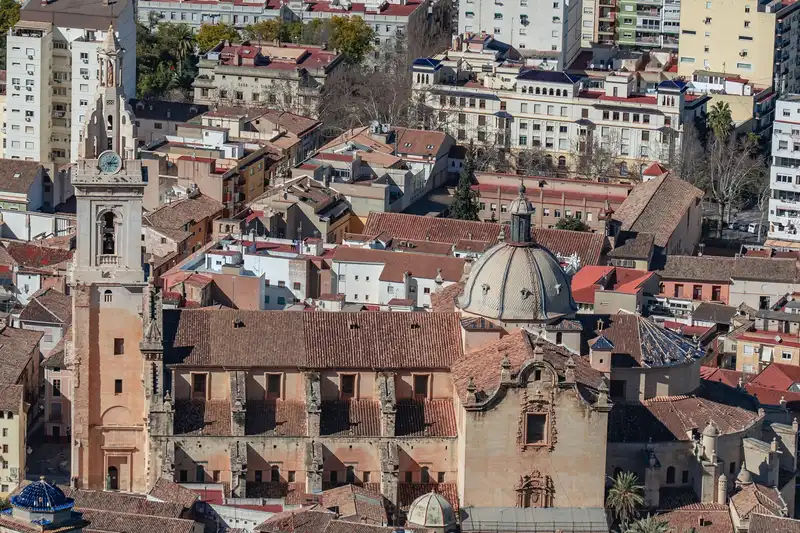
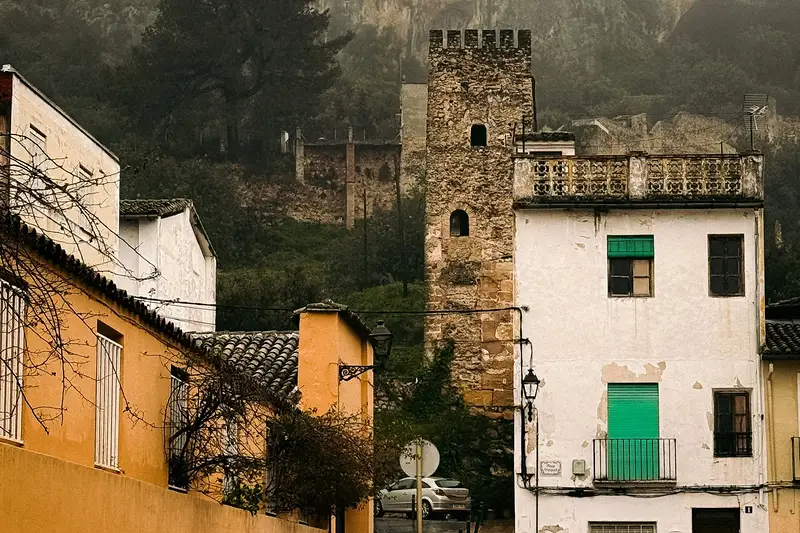
What I notice in practice is how much the old town hides. Recently I viewed a townhouse on a narrow street in the old town, spread over three floors. On the ground floor was a former shop, with its original historic shopfront still in place, and at the top a small roof terrace with a stunning view of the castle. All of that for well under €150,000, the kind of house that would cost a fortune in the center of Valencia.
The Towns: Where to Live in La Costera
La Costera has 19 municipalities, from a city of 31,000 to villages of a few hundred people. Population figures are from Spain's statistics office (INE, January 2025).
Regional capital · Castle town · Train to Valencia
Xàtiva
31,008 inhabitants
Xàtiva is the capital of the region. It has the hospital, the train station, a British school, shops, restaurants and a full cultural calendar. The old town climbs the hill toward the castle, with churches, palaces and fountains, steep streets and little parking. Around the tree-lined Albereda (Alameda) and toward the station, the center is flatter, with apartment buildings and shops. Newer neighborhoods and houses with gardens lie on the edges of town.
Suits: buyers who want a city with history and every service within walking distance, and families who want a British school nearby.
Working town · Low prices · Sant Antoni bonfire
Canals
13,746 inhabitants
Canals is a working town a few minutes south of Xàtiva, with its own industry, shops and schools. It has some of the lowest prices in the region. Its biggest night is 16 January, when the town burns one of the largest bonfires in Spain for Sant Antoni, a fiesta of national tourist interest since 2018.
Suits: buyers on a tighter budget who want a real town, not a village.
Quiet town · Train station
L'Alcúdia de Crespins
5,548 inhabitants
L'Alcúdia de Crespins is a small, quiet town next to Canals, with the shared train station on its edge.
Suits: buyers who want village life with a train to Valencia.
Wine country · More land · End of the C-2 line
Moixent and La Font de la Figuera
4,401 and 2,022 inhabitants
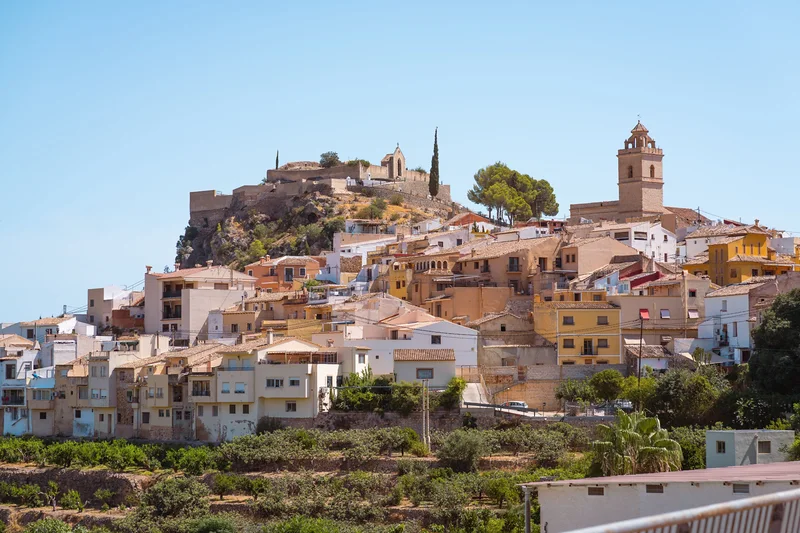
Moixent and La Font de la Figuera lie at the western end of the valley, close to the border with Castilla-La Mancha. This is wine country, part of the area known as Els Alforins, with vineyards, almond trees and more land for your money. Near Moixent lies the Bastida de les Alcusses, an Iberian town where the Guerrer de Moixent was found, a small bronze figure of a horseman that has become a symbol of Iberian culture. Moixent is the last stop on the C-2 line.
Suits: buyers who want land, space and quiet, and do not mind the distance to Valencia.
Mountain villages · Train station
Montesa and Vallada
1,128 and 3,091 inhabitants
Montesa and Vallada are small towns between L'Alcúdia and Moixent, both with a train station. Montesa's castle belonged to the Order of Montesa, a military order of knights, and was badly damaged by an earthquake in 1748; parts of it still stand above the village. Vallada is known for the rock faces and hermitages above the town, popular with climbers.
Suits: buyers who want a small village in the mountains with a link to the railway.
Village life · Gardens · Close to Xàtiva
The Villages Around Xàtiva
La Llosa de Ranes 3,765 · El Genovés 2,822 · Barxeta 1,578 · Rotglà i Corberà 1,171 · Novetlè 872
La Llosa de Ranes, El Genovés, Barxeta, Rotglà i Corberà and Novetlè lie just a few kilometers from Xàtiva. They offer village life and more houses with gardens, with the city's services close by. El Genovés is home to the Museu de la Pilota, a museum of pilota valenciana: a traditional Valencian ball game in which two teams hit a small, hard ball back and forth with their bare hands, either in the street or on a long walled court called a trinquet. It is still played in towns across the region, and a match is worth watching.
Suits: buyers who want a house with outdoor space and Xàtiva on their doorstep.
To the north, the Ribera Alta, with Alzira and its orange groves, has its own guide to living in Alzira and the Ribera Alta, and the coast at Cullera is covered in our guide to Cullera and the Ribera Baixa.
Schools and Healthcare for Families
International school
The British School of Xàtiva, a member of the National Association of British Schools in Spain (NABSS), teaches the British curriculum from age 0 to 18, up to A levels in the sixth form. The British School of Alzira is also within reach.
Public schools
In public schools, parents now choose whether their child is taught mainly in Spanish or Valencian (Ley 1/2024); children learn both.
Healthcare
Xàtiva has the region's public hospital, the Hospital Lluís Alcanyís, with a 24-hour emergency department, so most towns in this guide are less than half an hour from a hospital. Every town has its own health center (centro de salud), the first stop for a family doctor.
Daily Life in Xàtiva: Markets, Fiestas and Food
Xàtiva's weekly market fills the Plaça del Mercat on Tuesday and Friday mornings, from 8:00 to 14:00. Unlike a beach town, Xàtiva does not empty in winter: the shops, bars and schools are busy all year, because the people who live here work here.
The highlight of the year is the Fira d'Agost, the August Fair, held from 15 to 20 August. King Jaume I granted it in 1250, so the fair is more than 750 years old. It mixes a medieval market, a livestock fair, music, singing contests and a classic motorcycle race through the streets (Xàtiva tourist office). Xàtiva also celebrates the Fallas in March, when giant painted figures are burned in the streets, while the western towns hold Moors and Christians festivals. Our guide to Valencia's fiestas and what they mean when you buy a home explains what to ask before you choose a street.
The local dish is arròs al forn, rice baked in the oven with chickpeas, pork and sausage, and the classic sweet is arnadí, a dessert of pumpkin or sweet potato with almonds, sugar and cinnamon.
Nature and the Outdoors
The castle hill above Xàtiva is a walk in itself, with views over the town and the valley. Just outside town lies the Cova Negra, a cave where Neanderthals lived. Further west, the mountains around Montesa and Vallada draw hikers, mountain bikers and climbers, and the valleys toward Moixent are lined with vineyards and almond groves that flower in late winter. The beach at Gandia is about an hour away by car.
What Homes Cost in Xàtiva and La Costera
average asking price in Xàtiva, against €3,473 in Valencia city (Idealista, September 2026)
average asking price in Canals, a few minutes south of Xàtiva
Asking prices in Xàtiva average about €1,309 per square meter, compared with €3,473 in Valencia city and €2,208 for the province as a whole (Idealista, September 2026). In Canals, the average is about €811. So for the price of a small apartment in Valencia, you can often buy a whole townhouse in Xàtiva.
Prices are rising fast, though: in Xàtiva, asking prices are about a quarter higher than a year ago, and in the past two years I have seen more foreign buyers arrive.
Prices differ a lot from street to street. A renovated townhouse in the old town, an apartment near the station and a country house outside Moixent are different markets, so compare like with like.
The Honest Part: Heat, Old Houses and Distance
Heat: Xàtiva is one of the hottest towns in the Valencia region. In summer, temperatures near or above 40°C are common, and in July 2020 Xàtiva recorded 42.2°C, at that point the highest temperature of the year in Spain, according to Spain's weather agency AEMET. Look for thick walls, shade, good insulation and air conditioning, and visit in July before you decide.
Old houses: townhouses in the old town have character, but often also old wiring, damp and steep stairs. The old town is a protected heritage site (Bien de Interés Cultural), so changes to a facade, roof or layout need approval from a heritage committee of the town hall and the regional government. Check the state of the building and what you will be allowed to change before you make an offer.
Distance: Valencia and the beach at Gandia are both about an hour away by car. Beyond Xàtiva, trains are infrequent, so in most villages a car makes life much easier.
Flood and fire risk: parts of La Costera lie along rivers such as the Albaida and the Cànyoles and their gullies (barrancos), so check any address on the official PATRICOVA flood map. In the pine-covered hills, wildfire is a real risk in summer, so look at how close a house is to the forest.
A small international community: more foreigners are arriving, but Xàtiva is still very much a Spanish town. For some buyers that is exactly the point; for others it can feel isolating at first. Learning some Spanish makes a real difference.
Country Living: Olives, Almonds and Vineyards
Much of the land in La Costera is dry farmland (secano), with olive, almond and carob trees, and vineyards in the west. Irrigated land (regadío) lies mainly near the rivers. Land costs less than near the coast, but the rules are strict.
Good to know
In the Valencian Community, a new house on common rural land needs a plot of at least one hectare (Valencian planning law, TRLOTUP), so buying an existing legal house is usually the realistic route.
Our guide to buying a country house in Valencia explains what to check, and our guide to self-sufficient living near Valencia covers water, solar and animals.
Who Living in Xàtiva and La Costera Suits
Families
A British school and a hospital in town, at prices far below Valencia.
Remote workers and commuters
A real town with a train to Valencia, for the cost of a small city apartment.
Retirees
The flatter parts of central Xàtiva, with the market, doctors and cafés within walking distance.
Buyers who want land
The countryside around Moixent, La Font de la Figuera and the villages near Xàtiva.
Buyers on a budget
Canals, with some of the lowest prices in the province, and nearby L'Alcúdia de Crespins.
It suits you less if you want the beach every day, an international community, or mild summers. For an overview of other areas, see our guide to the best areas to buy property in Valencia.
A Real Spanish Town, an Hour From Valencia
Xàtiva is not a resort and not a suburb. It is a historic town with its own life, its own hospital and its own train to the city, where your money still buys space and character. Choose your street with care and plan for the summer heat, and it can be a very good place to live.
The agent showing you the house works for the seller. We work for you.
Not sure whether Xàtiva or La Costera suits you?
We search for you, identify the right home, check it before you make an offer, and negotiate the price. Book a free call and tell us how you want to live.
Book a free callWe will explain how we work and what it costs.
Frequently Asked Questions
Is Xàtiva a good place to live?
For buyers who want a real Spanish town with history and services at a fraction of Valencia's prices, yes. Xàtiva has a castle, an old town, a hospital, a British school and a train to Valencia, with asking prices around €1,300 per square meter. The downsides are hot summers, the distance to the beach and a still small international community.
How far is Xàtiva from Valencia?
About 68 km by road: 55 minutes to 1 hour 20 by car to the center of Valencia, depending on traffic, and 45 minutes to an hour to the airport.
Is there a train from Xàtiva to Valencia?
Yes. The Cercanías C-2 line runs from Xàtiva to Valencia's Estació del Nord in about an hour, every 15 to 30 minutes. A few faster trains a day take about 40 to 50 minutes.
What do houses cost in Xàtiva?
Asking prices average about €1,309 per square meter (Idealista, September 2026), compared with €3,473 in Valencia city. In nearby Canals, the average is about €811. Prices have risen by about a quarter in a year.
Are there international schools in Xàtiva?
Yes. The British School of Xàtiva teaches the British curriculum from age 0 to 18, up to A levels. The British School of Alzira is also within reach.
How hot does Xàtiva get in summer?
Very hot. Temperatures near or above 40°C are common in July and August, and Xàtiva regularly ranks among the hottest towns in the Valencia region. Winters are mild, with cool nights.
Is Canals a good place to live?
Yes, if you want a real working town at some of the lowest prices in the province, a few minutes from Xàtiva and its hospital, with a train station on the edge of town.